From left to right: Michelle Cook, Angela Hagenbach, Vincent Bell, Lucille Douglass, and Dan StilleyWreaths on the headstone of John Wesley MartinCalvin Arsenia sits with the harp while Michelle Cook speaks about John Wesley Martin
In the late-morning sun KCMC partners, project supporters, and members of the public arrived at the northeast quadrant of Union Cemetery for a memorial service hosted by the Salus Populi Pension Project held on October 26th. Participants gathered just off the paved path and under the shade of a handful of towering walnut trees to celebrate the life, story, and impact of John Wesley Martin. Wesley was a Black man born into slavery in 1839. At the rise of the Civil War, his enslaver left to join the Confederate army, giving Wesley the chance to travel to Kansas City, where he enlisted and fought for the Union army. He passed away on the 30th of March, 1901.
The memorial service lasted approximately 30 minutes and included a full ceremony, complete with acknowledgements, an invocation, soulful music and song performed with a harp, impactful readings, a laying of the wreath, and the life story of John Wesley Martin. Many attendees were visibly affected by the end of the beautiful service.
The Salus Populi Pension Project aims to create a public repository of pension file documentation from Missourian U.S. Colored Troops servicemen in an effort to make these narratives accessible and highlight the intricacies of post-war life for Black veterans. In their mission statement, the Salus Populi Pension Project makes it clear that they “believe the archive is not a place, or a collection, but a cacophony of voices which have been buried by prejudiced and underdeveloped archival infrastructure.” They conclude their statement with a resolute: “It’s time to listen.”
Directly following the memorial service, KCMC partners traveled a short distance to the Union Hill Event Hall for the final Quarterly Meeting of the year. Partners enjoyed a lunch buffet and chatted amongst themselves before a few short talking points led by KCMC team members. While the majority of the meeting revolved around budget deadlines and financial planning, speakers also stirred partner interest in the next upcoming Era of Rights Symposium (April 7-10, 2027) and in a call to action for future Oral History Harvests.
John Wesley Martin Memorial Service Program, from the Salus Populi Pension Project:
Savannah Lenhardt (left) interviews Maria Sears (right) for the Steptoe Oral History Harvest.
The Enhancing Every Neighborhood Organization hosted the Steptoe Oral History Harvest on October 3rd. Sponsored by the Kansas City Monuments Coalition (KCMC), the event marked progress in KCMC partner Steptoe Lives’ community initiative to preserve the history of the Steptoe neighborhood. The initiative involves documenting and sharing oral histories from surviving members of the Steptoe community in remembrance and celebration of the area’s vibrant past.
The Steptoe neighborhood is a historically Black middle-class enclave in Westport, Missouri that was also home to the Penn School. As one of the first Black schools west of the Mississippi, the Penn School served the community until it closed in 1955 following the Brown v. Board of Education ruling against segregation in schools. Oral histories collected at the Steptoe Oral History Harvest indulge a special interest in those voices who experienced the Penn School.
Participants coalesced on Saturday at the Westport Presbyterian Church for approximately four-and-a-half hours to share their stories. Five interviewers moderated conversations with 11 contributors, yielding nine hours of video and an additional hour of audio recording. The recorded media will be shared with the Black Archives of Mid-America and the Kansas City Public Library (KCPL) to be presented to the public.
Steptoe Lives, in addition to sharing oral histories, plans to create a website dedicated to the Steptoe neighborhood and its legacy.
On September 10th, 15 historians converged at the Plaza Branch of the Kansas City Public Library to workshop chapter drafts concerning marginalized voices fighting for civil rights in the 20th-century Kansas City metro. The project “An Era of Rights: Kansas City’s Struggle for Equality” is led by the UMKC’s Kansas City Monuments Coalition (KCMC) and the Kansas City Public Library (KCPL) in a joint effort to create a centralized hub for late 20th-century Kansas City civil rights and activism information, historical documents, and public monuments devoted to the subject.
The project consists of two parts: a public-facing website with digitized historical documents and materials, and a published academic book on Kansas City’s marginalized communities and their activism. This project is the third collaboration between UMKC and KCPL. Both previous projects, “The Civil War on the Western Border” and “The Pendergast Years: Kansas City in the Jazz Age and Great Depression,” featured digitized sources, interpretive essays, and encyclopedic articles on a website, in conjunction with a published scholarly collection of essays. “An Era of Rights” follows this model, but is the first in conjunction with KCMC, a cooperative of public history organizations dedicated to telling unheralded stories in Kansas City.
As part of its central mission to represent a more inclusive history of the region, KCMC sponsored this workshop for the authors of the forthcoming edited volume connected to the project. The volume seeks to present Kansas City as a significant hotbed of civil rights activism by highlighting its diverse social justice movements, including Black civil rights, queer liberation, Chicana activism, and other community movements from 1950 to 2000.
Volume co-editors Sandra Enriquez, Rebecca Davis, and Bridget Haney led scholars in presenting their research for peer review at the Kansas City Public Library on September 10th and 11th. Over the course of these two days, each author discussed their work and received about an hour of individualized feedback from the group. Contributors jumped into discussion and critique regarding progress on each essay draft, proposing new angles on arguments, potential interviewees for oral histories, additional reference materials, suggestions on how to best represent the communities they write about, and alternative directions to take each piece. Many took advantage of additional mealtimes to collaborate and make connections about their work. The workshop concluded with a collaborative discussion on Kansas City’s role and significance to civil rights history in the Midwest and nationally.
Next year, contributing scholars will present their research at the Central Branch of the Kansas City Public Library on April 9th and 10th at a public symposium hosted by KCMC. Community members, activists, spiritual leaders, and others will also be invited to present at the symposium to address their various struggles for equality in the city. More information on this event to come.
Dr. James Grossman (left) delivering his public conversation “Why History Matters” with Dr. David Trowbridge (right)at the Kansas City Public Library Plaza Branchin the Truman Forum Auditorium.
The Center for Digital and Public Humanities and Kansas City Monuments Coalition (KCMC) hosted Dr. James Grossman for a series of events this September. Dr. Grossman met with KCMC project partners for a public workshop at the Kauffman Foundation Conference Center and subsequently spoke to a public audience at the Kansas City Public Library (KCPL). This was the third event in KCMC’s lecture series following Dr. Stephen Aron’s lecture last fall and Dr. Thavolia Glymph’s lecture in April. Dr. Grossman’s public lecture, “Why History Matters,” will be available to watch online on the Kansas City Public Library’s YouTube channel.
Dr. Grossman is a well-respected, lifelong historian with many publications, projects, and consultations. He is the author of Land of Hope: Chicago, Black Southerners, and the Great Migration and A Chance to Make Good: African-Americans, 1900–1929.Land of Hope won both the Gustavus Myers Center Outstanding Book Award and the Illinois State Historical Society: Russell P. Strange Memorial Book of the Year Award. A Chance to Make Good won awards from New York Public Library and the National Council for the Social Studies. Notably, he also served as the previous Executive Director of the American Historical Association (AHA) from 2010 to 2025. The AHA is a professional association of historians that provide leadership in history, foster collaboration between international voices, and promote community-engaging historical work, among other initiatives. They organize regional conferences, workshops and lectures, publish and review literature on American history and best practices, award grants to support research, advocate for history and historians in the legal sphere, and more. The AHA is made up of over 10,000 members and is a leading force in the profession.
Dr. Grossman’s extensive experience in the field made him an ideal speaker for KCMC’s community partners, as he has navigated shifting public sentiments and contested interpretations of our nation’s past. During the September 8th workshop, Dr. Grossman introduced himself and discussed his role in the AHA and its greater role in both the humanities and in communities. Dr. Grossman spoke about the function of monuments in the community, as statements of value, and their role in shaping the future. After a short presentation, he initiated dialogue from KCMC partners about addressing difficult histories and their representations in the Kansas City area.
Dr. Grossman’s September 9th public conversation entitled “Why History Matters” concerned the role of the historian during times of political unrest, history as a community-building force, and the high-stakes repercussions of historical misrepresentation. He participated in an informed and engaging dialogue with Dr. David Trowbridge. The conversation first covered the state of the field and what it means to interact with patriotic education, then diverged into an audience-based discussion.
For information about KCMC’s upcoming events, check out the Calendar.
Aron began by discussing the use of the word “removal” in contemporary discourse regarding the U.S. government’s treatment of Indigenous peoples in the wake of the Indian Removal Act of 1830, instead recommended verbiage such as “ethnic cleansing” or “expulsion.” He then provided an overview of late 20th-century and early 21st-century initiatives aimed at reparations for Indigenous peoples, highlighting both their achievements and their failures. Aron, who assumed leadership of the Autry Museum of the American West in 2021, was also able to provide insights into the nature of repatriation, a term that in recent years has been increasingly used to describe not just the return of land to Indigenous peoples but also the return of art and artifacts by museums. The fourth portion of Aron’s lecture was dedicated to the restorative possibilities for both museums and Indigenous peoples when reconciliation is pursued more holistically. “With trust earned through generous returns,” Aron said, “museums can forge a new compact with Native peoples built on mutual respect, shared stewardship, and joint exhibition making.” The lecture concluded with a chance for audience members to ask Aron questions.
Director, president, and CEO of the Autry Museum, Aron is also Professor Emeritus of History at UCLA. He earned his Ph.D. from the University of California, Berkeley, and is the author of numerous books, including most recently Peace and Friendship: An Alternative History of the American West.
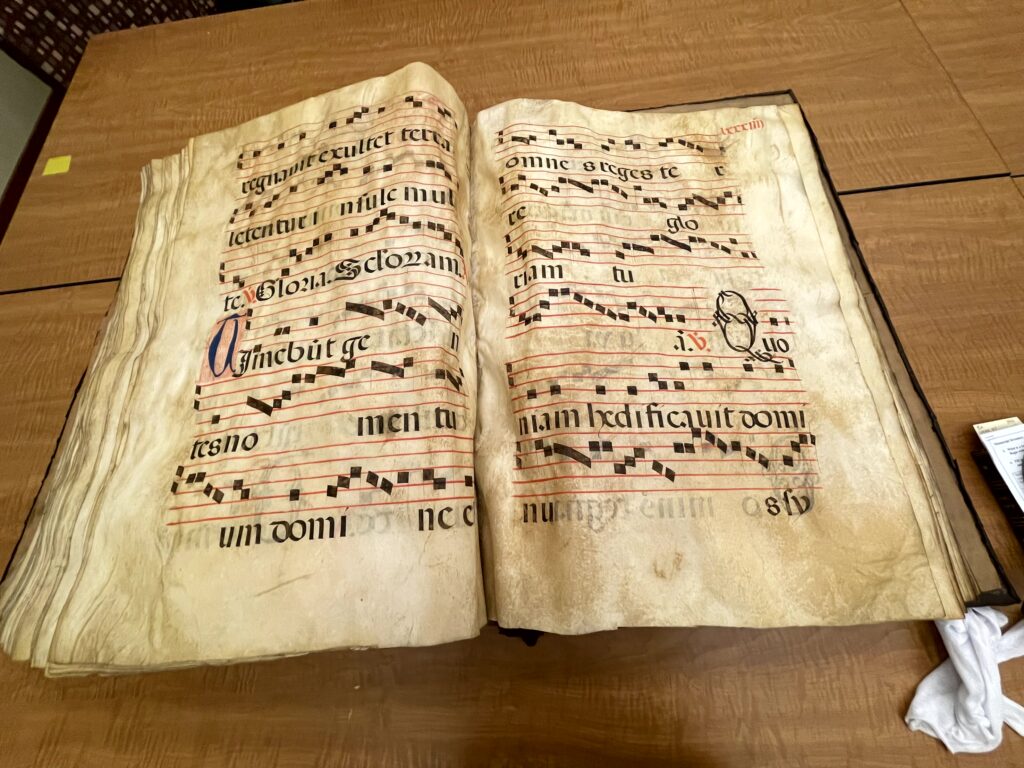
Antiphonal from the Colonel Greene Collection, University of Marquette. Photo by UMKC Student MaAh Kyi.
UMKC is one of multiple participants in a $2.5 million (Canadian) partnership grant from the Social Sciences and Humanities Research Council of Canada. Led by Dr. Jennifer Bain of Dalhousie University in Nova Scotia, the Digital Analysis of Chant Transmission (DACT) project aims to facilitate large-scale study of the development of plain chant (often termed Gregorian chant) after the European Middle Ages. Focusing on the movement of Latin liturgical chant beyond Europe into Indigenous and Settler communities, the project seeks to document sources through the digital platforms CANTUS Database and CANTUS Index.
Virginia Blanton, Curators’ Distinguished Professor of English, is co-applicant and will lead an international working group of musicologists, students, and volunteers to investigate Cantorales in the Americas and Beyond, which seeks to preserve data about chant books produced in the Spanish diaspora between 1350 and 1800. Blanton indicates that “there are a number of Spanish liturgical manuscripts in North, Central, and South America, many of which have never been catalogued, much less studied. Our group aims to make these resources known.” Such books are often very large manuscripts that were used by a choir in liturgical performance. There are two in LaBudde Special Collections at Miller Nichols Library, one donated by Conservatory alumnus James Adair and another saved by librarians who literally “passed the hat” to buy it from a Mission, Kansas frame shop, where it was being dismantled and sold leaf by leaf. “UMKC students have been hard at work investigating both of these manuscripts, providing inventories of the chant in them and researching their histories. The results of their multidisciplinary work are now preserved in the CANTUS Database,” Blanton said.
In developing learning opportunities for UMKC students, Blanton has collaborated with Bain at Dalhousie, as well as Dr. Debra Lacoste at the University of Waterloo, where the CANTUS platforms are maintained. When Blanton suggested that they might ask a group of musicologists to identify similar books for DACT, they asked her to lead the project into future discoveries. “Jennifer and Debra were so excited by the work UMKC students are doing—and by the mentorship I was providing. They emphasized that our collaborative model is the ideal scenario for the project I had suggested. Working with students on these books has been so rewarding, so I jumped at the chance.” The working group includes academic researchers from Spain, Guatemala, Australia, and North America, who will develop a crowd-sourcing document that will allow librarians and archivists, as well as musicians, Roman Catholic clergy, and nuns to share data about books in their collections. Largely, such books have been shelved since the early nineteenth century and forgotten. Their work aims to make digital entries for the resources they find so they can become known to the international community for future scholarship. Students will be a key part of that endeavor.
A group of seven UMKC student volunteers worked last year to trace manuscripts across the US, using print and digital indices. As Blanton notes, “We have only scratched the surface and have yielded over one hundred books. There are, most certainly, many more that have not been catalogued.” One, for example, Blanton found while visiting colleagues at Benedictine College to look at another manuscript. “It was such a lovely surprise but not a surprise,” she says. “Wherever I go, I learn about similar books and it seems important to document them and think about what they reveal about why these books were so important in the Americas. There is the dark side of this story—the history of colonization, in which Spaniards forced conversion of native peoples to Roman Catholicism—and there are fascinating results, such as books that illustrate how indigenous peoples adopted, transformed, and sustained chant in their native languages as well as in Latin. This revelation is at the heart of what we hope to understand as this project moves forward.” UMKC will receive $45,000 of the partnership grant to support student research over a three-year period. By studying the transmission of chant, the team will help uncover economic, social, cultural and intellectual values through the stories of chant manuscripts, and the human stories that accompany them.
The CODICES Digital Humanities Lab, founded by Blanton, Dr. Jeff Rydberg-Cox (English and Classics), and Dr. Nathan Oyler (Chemistry) in 2011, will provide imaging support for the Cantorales project. The Lab’s investigation of the Adair Chant Book is part of a current Digital Advancement Grant from the National Endowment for the Humanities, in which the team, along with colleagues Yugyung Lee (Computer Science) and Zhu Li (Computer Science), is using the palimpsests in the book as a testbed for an alternative deep learning model to multispectral imaging.
The UMKC Center for Digital and Public Humanities is pleased to announce that the Center for Midwestern Studies, which is associated with the DPH Center, has been awarded a $190,000 Landmarks of American History and Culture Grant from the National Endowment for the Humanities. The Landmarks program funds “workshops for K-12 educators that enhance and strengthen humanities teaching.” The NEH Landmark’s program funded only 16 workshops throughout the nation. Diane Mutti Burke, Sandra Enríquez, David Trowbridge, and Rachel Forester from the History Department will organize and deliver the workshops next summer.
Educators from throughout the nation will travel to UMKC in Summer 2024 to attend a week-long workshop called Wide-Open Town: Kansas City during the Jazz Age and Great Depression. Guided by a team of historians and museum professionals, the Wide-Open Town K-12 educators will gain a deeper understanding of the important role that Kansas City played in the transformation of America in the decades between the two world wars. The teachers, who will be selected through a competitive application process, will visit museums and cultural institutions, including the National WWI Museum, the Truman Library and Museum, the Nelson-Atkins Museum of Art, the Thomas Hart Benton State Historic Site, the 18th and Vine Historic District, the Country Club Plaza, and the Guadalupe Centers that illuminate this history.
At the crossroads of American transportation networks and cultural norms, Kansas City in the 1920s and 1930s typified broad trends in American history. The decades bounded by the world wars were marked by intense political, social, and economic change as the United States reluctantly took its place on the world stage while simultaneously struggling with significant challenges at home. The upheaval of World War I, the massive migration of people of color into urban America, the entrance of women into both the labor force and electoral politics, resistance to Prohibition and changing social mores, and an economic collapse and near revolution in national politics all redefined the national character. Understanding how these changes influenced Kansas City—and how the city responded—reveals how citizens of the age adapted to the rise of modern America.
Building upon the success of a previous workshop that focused on the Missouri-Kansas region in the Civil War, the Wide-Open Town workshop will mark the seventh time that UMKC has hosted a Landmarks of American History and Culture teacher program. Program director Diane Mutti Burke believes the NEH’s support for this new program reflects both the agency’s confidence in the UMKC team to deliver an excellent educational experience for the teachers and an acknowledgement of Kansas City’s important role in US history. “My colleagues and I believe that understanding this city’s history is crucial to understanding the history of the early twentieth century United States. We are excited to share this important history and the city’s wonderful historical landmarks with primary and secondary school educators from throughout the nation.”
For more information, please contact Diane Mutti Burke at midwest@umkc.edu.
The grant will support a virtual meeting in November and a two-day in-person meeting in New York City next spring of humanities societies that represent reading, writing, and languages to discuss critical AI literacies. Anticipated participants include: Association of Research Libraries (tentative); Association of Language Departments (confirmed); College Language Association (tentative); Council of Writing Program Administrators (confirmed); International Writing Center Association (confirmed); Teaching English to Speakers of Other Languages and CCCC Send Language Standing Group (confirmed); and Two Year College Association (confirmed). Dr. Byrd and task force members expect to discuss topics of mutual interest, including the following:
Shared priorities for generative AI interventions
Additional resources that the organizations can create, commission, or curate to advance critical AI literacy
Planning for a gathering of language, literature, and literature professionals, convened with sessions presenting research and opportunities for conversation around AI and writing
A topic for the task force’s second working paper, possibly centered on the development of critical AI literacy
As classroom instructors and students face the disruptive changes brought about by the expansion of AI, the MLA-CCC Joint Task Group will help to identify constructive approaches for those who teach students reading, writing, and languages. The Center for Digital and Public Humanities and the English Department are pleased that our UMKC colleague will play a vital role in helping educators to become more knowledgeable about the capabilities and uses of AI and consider how they might use this increasingly pervasive tool in the classroom.
The Center for Digital and Public Humanities is delighted to announce the launch of Unraveling Workers’ Letters: The Voices Behind Nelly Don, a digital exhibit that brings forward the voices of women who worked at Kansas City’s Donnelly Garment Company (DGC) in the 1930s and resisted unionization by the International Ladies Garment Workers’ Union (ILGWU). The Donnelly Garment Company was one of the foremost producers of modestly priced dresses for American women in the early decades of the twentieth century. The company was founded and operated by Nell Donnelly, a highly successful businesswoman who undermined attempts to unionize her workers by implementing business practices that ensured their loyalty. The exhibit draws upon some 700 letters written by DGC employees in support of Donnelly and the working conditions she provided that are now archived at the State Historical Society of Missouri-Kansas City Research Center. The website interweaves images of the original letters written by historic Kansas City women and the research and writing of UMKC students, who examine the women’s experiences working at the Donnelly Garment Company and how they represented their work and relationship with the company’s owner in their writing.
The digital exhibit is a product of a course taught by Dr. Jane Greer, University of Missouri Curators’ Distinguished Teaching Professor of English and the director of the UMKC Office of Undergraduate Research and Creative Scholarship, on Rhetorics of Public Memory in Spring 2023. UMKC undergraduate students served as the exhibit’s curators. Students in the class were excited to work on a project that brings their research and writing to a public audience. Ella Whitfield (English BA, 2026) observed, “It was amazing to see all of our hard work put up for people everywhere to see.” Other students were pleased that they learned important practical skills through their work on the project. “Being able to do such an in-depth analysis of an incredible event in this city’s history provided me with skills I have never received in another class. Being immersed in the lives of these women was an experience I wouldn’t trade for the world,” explained Lauren Leetch (Communication and English BA, 2025). The Unraveling Workers’ Letters digital exhibit was supported by a Center for Digital and Public Humanities fellowship in 2022-23.
Dr. Greer’s research focuses on the rhetoric of American women and how they represented themselves and their identities and concerns through their writing. Dr. Greer recently published Unorganized Women: Repetitive Rhetorical Labor & Low-Wage Workers, 1834-1937 with the University of Pittsburgh Press. The book profiles case studies that “reveal noteworthy patterns in how these women’s words helped to construct the complex web of class relations in which they were enmeshed. Rather than a teleological narrative of economic empowerment over the course of a century, Unorganized Women speaks to the enduring obstacles low- and no-wage women face, their creativity and resilience in the face of adversity, and the challenges that impede the creation of meaningful coalitions.” Dr. Greer shared her research shortly after her book’s publication at a talk at the Kansas City Public Library to an audience of over 100.