
Figural Urn, Zapotec, 500–600 C.E. Clay and pigment, 25 x 25 x 12 1/2 inches (63.5 x 63.5 x 31.75 cm). The Nelson-Atkins Museum of Art, Purchase: William Rockhill Nelson Trust, 61-16
UMKC will host a symposium in conjunction with the Nelson-Atkins Museum of Art exhibition “Painted Worlds: Color and Culture in Mesoamerican Art.” The event will take place February 5th, 6th, and 7th across locations at both UMKC and the Nelson-Atkins. A full schedule for all three days of events is available here.
On Thursday, February 5th, representatives of the Los Angeles County Museum of Art, the Nelson-Atkins, and the New York Metropolitan Museum of Art will gather at the Atkins Auditorium for a pre-symposium lecture and discussion about new projects that will challenge traditional art, historical, and museum models, and explore how updating museum architecture can foster new ways of engaging with historical collections. This event is free and open to the public, and attendees can register here.
Two panels—“Color and Materiality in Mesoamerican Art” and “Color, Gender, and Identities in Mesoamerican Art”—will take place on the first official day of the symposium, Friday, February 6th, at UMKC’s Miller Nichols Learning Center, and will be followed by a reception and codex facsimile viewing. Day one will conclude with a Schutz Lecture Series keynote talk, “A Gleam in the Forest: Meaning and Material in Maya Color,” by Stephen D. Houston of Brown University.
Day two events will be held in the Atkins Auditorium at the Nelson-Atkins, and will include a panel on “Nature, Materials, and Metaphors,” a keynote from Byron Ellsworth Hamann titled “Jazz Age Maya: Mysteries of a Modern Prehispanic Book in 1930s Kansas City,” and a panel on “Leaving and Returning to Nature: Modern and Contemporary Artistic Practices.” Registration is free and open to the public for both full days of events.
The cover of DH+BH: An Interdisciplinary Collection on Digital Humanities and Book History, recently published by the Illinois Open Publishing Network.
Spencer D. C. Keralis, co-director of the Center for Digital and Public Humanities, co-edited a collection of essays recently published by the Illinois Open Publishing Network. The book, DH+BH: An Interdisciplinary Collection on Digital Humanities and Book History, features eight essays written by fourteen contributors and is available for free online via Publishing Without Walls, a digital scholarly publishing initiative at the University of Illinois.
Keralis and their fellow co-editor Cait Coker, associate professor and curator of Rare Books and Manuscripts at the University of Illinois at Urbana-Champaign, gathered writings that examine how digital humanities and book history can be applied to advocacy, activism, and recovery work. “I wanted to create space for folks who often find themselves on the margins of academic disciplines,” Keralis said. “I also wanted to highlight work that demystified and critiqued the essential infrastructure of DH and book history: digital collections, the processes of mass digitization, and the often-hidden labor that supports these systems.”
The collection—which takes its name from a 2022 virtual conference—covers topics such as feminist recovery work, the limitations of representation in digital collections, digital methodologies for the enrichment of book history, and interdisciplinary approaches to book history scholarship.
Lucille H. Douglass, chairperson of the Banneker School Foundation and Historic Site, cuts the ribbon at a ceremony celebrating the restoration of the schoolhouse.
The Banneker School Foundation and Historic Site recently celebrated the completion of the school’s restoration by hosting a ribbon cutting ceremony at the schoolhouse in Parkville, Missouri. Attended by various community members, alumni, and friends, the event celebrated the 140th anniversary of the kilning of the bricks used for the original schoolhouse, and honored the 40 years of work that have made the restoration possible. The Banneker School, named after Benjamin Banneker (1731-1806), an African American mathematician, astronomer, and racial equality advocate, is one of the few remaining one-room schoolhouses west of the Mississippi, and was originally one of just three schools built in Platte County to educate African American children.
Various figures involved in the restoration process shared remarks leading up to the ribbon cutting, including people from DMRTISANS, the Platte County Commission, the City of Parkville, Park University, the Park Hill School District, and the Platte County Historical Society, as well as Missouri State Representative Mike Jones and Missouri State Senator Barbara Washington. The Reverend Randy Sly of St. Therese Catholic Church opened the event with an invocation, and the culminating ribbon cutting and dedication were preceded by a benediction from a Banneker School descendant, the Reverend Atwood Williams of Greater Faith Missionary Baptist Church.
Various attendees at the ribbon cutting ceremony. From left: Sheryl Bierman, Catherine Friends Middleton, Dr. Sandra Enríquez, Maggie Neel, Michael Sprague, Dr. Diane Mutti Burke, Lucille H. Douglas, Dr. David Trowbridge, Carla Barksdale, Dr. Adrian Singletary, and Connie Friends. Dr. Mutti Burke holds a piece of commemorative artwork created for the occasion.
Through support and funding provided by the Kansas City Monuments Coalition and the Mellon Foundation, the Banneker School Foundation and Historic Site has installed ten historic markers, erected an entry sign and shelter at the entrance to the property (with solar-powered security cameras and landscape lighting), engineered an ADA compliance study, surveyed property to the north of the original school, and carried out landscaping and grading of the site. The foundation looks forward to opening the historic schoolhouse’s doors to the community and continuing to honor “the enduring spirit of those who fought for education and equality in Parkville’s history.”
Sancho Panza in the 20th Century, one of six panels that comprise the Don Quixote murals painted by Luis Quintanilla in UMKC’s Haag Hall.
The KCUR podcast A People’s History of Kansas City released an episode this month devoted to the Luis Quintanilla murals in UMKC’s Haag Hall. The murals, which were recently restored by the Spanish fresco restoration specialists Beatriz del Ordi and Iñaki Gárate Llombart, were painted in 1940 by Quintanilla during his brief tenure at UMKC (then the University of Kansas City) while in exile from fascist Spain.
Quintanilla had been appointed by the university’s president Clarence Decker to serve as resident artist, training apprentices and using UKC students, faculty, and staff members as models for the murals. Six large panels comprise the Haag artwork: Don Quixote in the Real World, Sancho Panza in the Real World,Don Quixote in the Ideal World, Sancho Panza in the Ideal World, Don Quixote in the 20th Century, and Sancho Panza in the 20th Century.
The podcast episode covered the history of the murals and of Quintanilla’s activities in Kansas City, featured interviews with UMKC faculty members and the restoration’s principal investigators Viviana Grieco, Ph.D., and Dr. Alberto Villamandos, Ph.D., and detailed the various styles employed by Quintanilla in the murals, including buon fresco, classical Renaissance and Baroque-style painting, a grotesqueness akin to that of Francisco Goya, as well as a modernist rejection of traditional ideas associated with European art.
The restoration is just one of many initiatives made possible by the Kansas City Monuments Coalition, which was created by UMKC after the university was awarded a $4 million grant from the Mellon Foundation. KCMC supports preservation and commemorative organizations across Kansas City, such as the Fort Osage National Historic Site, Missouri Town, and the Wornall-Majors House Museums.
Quintanilla’s murals were also the subject of a recent event on campus, “Making the Imaginary Real: Luis Quintanilla’s Don Quixote Murals.” The event was a lecture featuring Patrick Lenaghan, a scholar at the Hispanic Society of America, and Christine Kierig, a Ph.D. candidate at the University of California Berkeley. The lecture covered the challenges faced by artists attempting to illustrate Don Quixote and concluded with a guided tour of the murals.
Aron began by discussing the use of the word “removal” in contemporary discourse regarding the U.S. government’s treatment of Indigenous peoples in the wake of the Indian Removal Act of 1830, instead recommended verbiage such as “ethnic cleansing” or “expulsion.” He then provided an overview of late 20th-century and early 21st-century initiatives aimed at reparations for Indigenous peoples, highlighting both their achievements and their failures. Aron, who assumed leadership of the Autry Museum of the American West in 2021, was also able to provide insights into the nature of repatriation, a term that in recent years has been increasingly used to describe not just the return of land to Indigenous peoples but also the return of art and artifacts by museums. The fourth portion of Aron’s lecture was dedicated to the restorative possibilities for both museums and Indigenous peoples when reconciliation is pursued more holistically. “With trust earned through generous returns,” Aron said, “museums can forge a new compact with Native peoples built on mutual respect, shared stewardship, and joint exhibition making.” The lecture concluded with a chance for audience members to ask Aron questions.
Director, president, and CEO of the Autry Museum, Aron is also Professor Emeritus of History at UCLA. He earned his Ph.D. from the University of California, Berkeley, and is the author of numerous books, including most recently Peace and Friendship: An Alternative History of the American West.
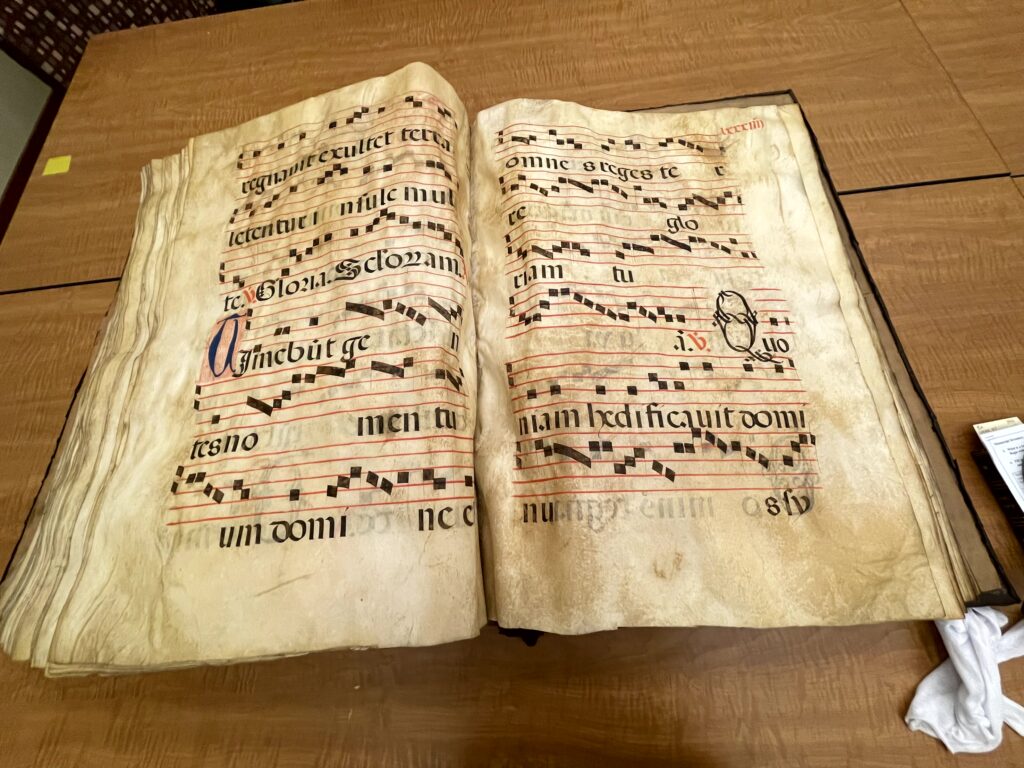
Antiphonal from the Colonel Greene Collection, University of Marquette. Photo by UMKC Student MaAh Kyi.
UMKC is one of multiple participants in a $2.5 million (Canadian) partnership grant from the Social Sciences and Humanities Research Council of Canada. Led by Dr. Jennifer Bain of Dalhousie University in Nova Scotia, the Digital Analysis of Chant Transmission (DACT) project aims to facilitate large-scale study of the development of plain chant (often termed Gregorian chant) after the European Middle Ages. Focusing on the movement of Latin liturgical chant beyond Europe into Indigenous and Settler communities, the project seeks to document sources through the digital platforms CANTUS Database and CANTUS Index.
Virginia Blanton, Curators’ Distinguished Professor of English, is co-applicant and will lead an international working group of musicologists, students, and volunteers to investigate Cantorales in the Americas and Beyond, which seeks to preserve data about chant books produced in the Spanish diaspora between 1350 and 1800. Blanton indicates that “there are a number of Spanish liturgical manuscripts in North, Central, and South America, many of which have never been catalogued, much less studied. Our group aims to make these resources known.” Such books are often very large manuscripts that were used by a choir in liturgical performance. There are two in LaBudde Special Collections at Miller Nichols Library, one donated by Conservatory alumnus James Adair and another saved by librarians who literally “passed the hat” to buy it from a Mission, Kansas frame shop, where it was being dismantled and sold leaf by leaf. “UMKC students have been hard at work investigating both of these manuscripts, providing inventories of the chant in them and researching their histories. The results of their multidisciplinary work are now preserved in the CANTUS Database,” Blanton said.
In developing learning opportunities for UMKC students, Blanton has collaborated with Bain at Dalhousie, as well as Dr. Debra Lacoste at the University of Waterloo, where the CANTUS platforms are maintained. When Blanton suggested that they might ask a group of musicologists to identify similar books for DACT, they asked her to lead the project into future discoveries. “Jennifer and Debra were so excited by the work UMKC students are doing—and by the mentorship I was providing. They emphasized that our collaborative model is the ideal scenario for the project I had suggested. Working with students on these books has been so rewarding, so I jumped at the chance.” The working group includes academic researchers from Spain, Guatemala, Australia, and North America, who will develop a crowd-sourcing document that will allow librarians and archivists, as well as musicians, Roman Catholic clergy, and nuns to share data about books in their collections. Largely, such books have been shelved since the early nineteenth century and forgotten. Their work aims to make digital entries for the resources they find so they can become known to the international community for future scholarship. Students will be a key part of that endeavor.
A group of seven UMKC student volunteers worked last year to trace manuscripts across the US, using print and digital indices. As Blanton notes, “We have only scratched the surface and have yielded over one hundred books. There are, most certainly, many more that have not been catalogued.” One, for example, Blanton found while visiting colleagues at Benedictine College to look at another manuscript. “It was such a lovely surprise but not a surprise,” she says. “Wherever I go, I learn about similar books and it seems important to document them and think about what they reveal about why these books were so important in the Americas. There is the dark side of this story—the history of colonization, in which Spaniards forced conversion of native peoples to Roman Catholicism—and there are fascinating results, such as books that illustrate how indigenous peoples adopted, transformed, and sustained chant in their native languages as well as in Latin. This revelation is at the heart of what we hope to understand as this project moves forward.” UMKC will receive $45,000 of the partnership grant to support student research over a three-year period. By studying the transmission of chant, the team will help uncover economic, social, cultural and intellectual values through the stories of chant manuscripts, and the human stories that accompany them.
The CODICES Digital Humanities Lab, founded by Blanton, Dr. Jeff Rydberg-Cox (English and Classics), and Dr. Nathan Oyler (Chemistry) in 2011, will provide imaging support for the Cantorales project. The Lab’s investigation of the Adair Chant Book is part of a current Digital Advancement Grant from the National Endowment for the Humanities, in which the team, along with colleagues Yugyung Lee (Computer Science) and Zhu Li (Computer Science), is using the palimpsests in the book as a testbed for an alternative deep learning model to multispectral imaging.

The UMKC Center for Digital and Public Humanities is pleased to announce that the Center for Midwestern Studies, which is associated with the DPH Center, has been awarded a $190,000 Landmarks of American History and Culture Grant from the National Endowment for the Humanities. The Landmarks program funds “workshops for K-12 educators that enhance and strengthen humanities teaching.” The NEH Landmark’s program funded only 16 workshops throughout the nation. Diane Mutti Burke, Sandra Enríquez, David Trowbridge, and Rachel Forester from the History Department will organize and deliver the workshops next summer.
Educators from throughout the nation will travel to UMKC in Summer 2024 to attend a week-long workshop called Wide-Open Town: Kansas City during the Jazz Age and Great Depression. Guided by a team of historians and museum professionals, the Wide-Open Town K-12 educators will gain a deeper understanding of the important role that Kansas City played in the transformation of America in the decades between the two world wars. The teachers, who will be selected through a competitive application process, will visit museums and cultural institutions, including the National WWI Museum, the Truman Library and Museum, the Nelson-Atkins Museum of Art, the Thomas Hart Benton State Historic Site, the 18th and Vine Historic District, the Country Club Plaza, and the Guadalupe Centers that illuminate this history.
At the crossroads of American transportation networks and cultural norms, Kansas City in the 1920s and 1930s typified broad trends in American history. The decades bounded by the world wars were marked by intense political, social, and economic change as the United States reluctantly took its place on the world stage while simultaneously struggling with significant challenges at home. The upheaval of World War I, the massive migration of people of color into urban America, the entrance of women into both the labor force and electoral politics, resistance to Prohibition and changing social mores, and an economic collapse and near revolution in national politics all redefined the national character. Understanding how these changes influenced Kansas City—and how the city responded—reveals how citizens of the age adapted to the rise of modern America.
Building upon the success of a previous workshop that focused on the Missouri-Kansas region in the Civil War, the Wide-Open Town workshop will mark the seventh time that UMKC has hosted a Landmarks of American History and Culture teacher program. Program director Diane Mutti Burke believes the NEH’s support for this new program reflects both the agency’s confidence in the UMKC team to deliver an excellent educational experience for the teachers and an acknowledgement of Kansas City’s important role in US history. “My colleagues and I believe that understanding this city’s history is crucial to understanding the history of the early twentieth century United States. We are excited to share this important history and the city’s wonderful historical landmarks with primary and secondary school educators from throughout the nation.”
For more information, please contact Diane Mutti Burke at midwest@umkc.edu.
The grant will support a virtual meeting in November and a two-day in-person meeting in New York City next spring of humanities societies that represent reading, writing, and languages to discuss critical AI literacies. Anticipated participants include: Association of Research Libraries (tentative); Association of Language Departments (confirmed); College Language Association (tentative); Council of Writing Program Administrators (confirmed); International Writing Center Association (confirmed); Teaching English to Speakers of Other Languages and CCCC Send Language Standing Group (confirmed); and Two Year College Association (confirmed). Dr. Byrd and task force members expect to discuss topics of mutual interest, including the following:
Shared priorities for generative AI interventions
Additional resources that the organizations can create, commission, or curate to advance critical AI literacy
Planning for a gathering of language, literature, and literature professionals, convened with sessions presenting research and opportunities for conversation around AI and writing
A topic for the task force’s second working paper, possibly centered on the development of critical AI literacy
As classroom instructors and students face the disruptive changes brought about by the expansion of AI, the MLA-CCC Joint Task Group will help to identify constructive approaches for those who teach students reading, writing, and languages. The Center for Digital and Public Humanities and the English Department are pleased that our UMKC colleague will play a vital role in helping educators to become more knowledgeable about the capabilities and uses of AI and consider how they might use this increasingly pervasive tool in the classroom.
The Center for Digital and Public Humanities is delighted to announce the launch of Unraveling Workers’ Letters: The Voices Behind Nelly Don, a digital exhibit that brings forward the voices of women who worked at Kansas City’s Donnelly Garment Company (DGC) in the 1930s and resisted unionization by the International Ladies Garment Workers’ Union (ILGWU). The Donnelly Garment Company was one of the foremost producers of modestly priced dresses for American women in the early decades of the twentieth century. The company was founded and operated by Nell Donnelly, a highly successful businesswoman who undermined attempts to unionize her workers by implementing business practices that ensured their loyalty. The exhibit draws upon some 700 letters written by DGC employees in support of Donnelly and the working conditions she provided that are now archived at the State Historical Society of Missouri-Kansas City Research Center. The website interweaves images of the original letters written by historic Kansas City women and the research and writing of UMKC students, who examine the women’s experiences working at the Donnelly Garment Company and how they represented their work and relationship with the company’s owner in their writing.
The digital exhibit is a product of a course taught by Dr. Jane Greer, University of Missouri Curators’ Distinguished Teaching Professor of English and the director of the UMKC Office of Undergraduate Research and Creative Scholarship, on Rhetorics of Public Memory in Spring 2023. UMKC undergraduate students served as the exhibit’s curators. Students in the class were excited to work on a project that brings their research and writing to a public audience. Ella Whitfield (English BA, 2026) observed, “It was amazing to see all of our hard work put up for people everywhere to see.” Other students were pleased that they learned important practical skills through their work on the project. “Being able to do such an in-depth analysis of an incredible event in this city’s history provided me with skills I have never received in another class. Being immersed in the lives of these women was an experience I wouldn’t trade for the world,” explained Lauren Leetch (Communication and English BA, 2025). The Unraveling Workers’ Letters digital exhibit was supported by a Center for Digital and Public Humanities fellowship in 2022-23.
Dr. Greer’s research focuses on the rhetoric of American women and how they represented themselves and their identities and concerns through their writing. Dr. Greer recently published Unorganized Women: Repetitive Rhetorical Labor & Low-Wage Workers, 1834-1937 with the University of Pittsburgh Press. The book profiles case studies that “reveal noteworthy patterns in how these women’s words helped to construct the complex web of class relations in which they were enmeshed. Rather than a teleological narrative of economic empowerment over the course of a century, Unorganized Women speaks to the enduring obstacles low- and no-wage women face, their creativity and resilience in the face of adversity, and the challenges that impede the creation of meaningful coalitions.” Dr. Greer shared her research shortly after her book’s publication at a talk at the Kansas City Public Library to an audience of over 100.